
Key Takeaways
- HVLS fans provide broad airflow in crowded railway stations, enhancing passenger comfort and circulation.
- Understanding Railway Station fan Price involves assessing fan size and electrical requirements for effective installation.
- Austar Technologies' HVLS fans use advanced German motors for reliable performance in large public areas.
- Proper fan selection considers dimensions, ceiling height, and passenger seating layout for optimal airflow coverage.
- Our fans can be adjusted for varying occupancy levels, ensuring consistent air movement for passenger comfort.
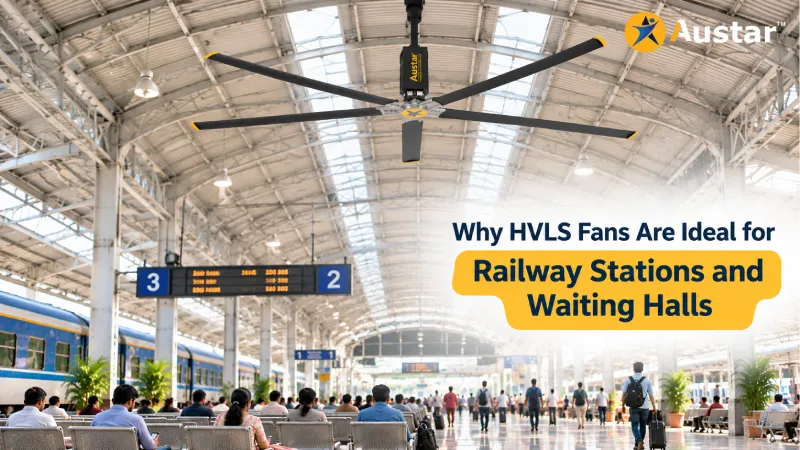
Crowded railway stations and waiting halls often face uncomfortable conditions because of limited air movement across large public areas. Small ceiling fans may circulate air around individual sections but struggle to serve expansive passenger spaces. At Austar Technologies, we manufacture industrial HVLS fans designed for railway and bus station applications. For facility managers researching Railway Station fan Price, understanding airflow performance, construction and operating controls is an important starting point.
Why Do Railway Stations Need High-Volume Air Circulation?
Railway stations accommodate passengers throughout the day, often across large halls with high ceilings. Air circulation becomes a significant consideration when waiting areas experience changing occupancy levels.
Our HVLS Fans for Railway Stations move large quantities of air at relatively low speeds. The resulting airflow can reach broader occupied areas than the concentrated circulation produced by smaller conventional ceiling fans.
Our railway station fan range uses aluminium components and geared motor technology. The specified fan speed reaches a maximum of 110 RPM, although actual operating requirements depend on the selected fan size.
In passenger waiting areas, consistent air movement can reduce the feeling of stuffiness. Airflow across seating sections may also help passengers feel more comfortable during longer waiting periods.
Our fans are designed for railway and bus station applications, giving public facility operators an option for large-area air circulation.
What Features Make Our HVLS Fans Suitable for Waiting Halls?
Waiting halls need ceiling-mounted equipment with practical controls and construction suited to large installations. Our railway station HVLS fans incorporate several features that support these requirements.
We use NORD or SEW German-make geared motors with reinforced bearings. The stated motor specifications include IP55 protection and an IE2 efficiency classification.
Our aluminium HE9-grade blades include two reinforcing ribs. A single-piece die-cast aluminium mounting hub connects the blade assembly to the motor arrangement.
The HVLS Fans for Waiting Halls also use variable frequency drives from listed manufacturers such as Lenze, Danfoss and Crompton.
Operators can control the fan through a keypad featuring start, stop, forward, reverse and speed adjustment functions.
This arrangement allows station personnel to manage airflow from an accessible control point rather than operating individual ceiling fans across several seating sections.
Plug-and-play cable connections are another specified feature, supporting installation and maintenance work.
How Can HVLS Fans Improve Passenger Comfort?
Passenger comfort depends partly on how air moves through waiting areas, particularly during periods of heavy occupancy. Our railway station fans distribute air over larger spaces through a high-volume, low-speed operating principle.
A large fan can create noticeable air movement around seating areas without relying on the concentrated airflow of several small ceiling fans.
Our Railway Station Cooling Solutions are designed to support air circulation in public buildings. While fans do not directly refrigerate indoor air, the movement of air can make occupied spaces feel more comfortable.
The adjustable VFD controller gives operators flexibility when passenger numbers or operating conditions change. Fan speed can be increased or reduced according to the required air movement.
Our team also considers the practical difference between a railway platform and an enclosed waiting hall. Their layouts and mounting conditions may vary, so fan selection should reflect the actual installation environment.
What Should Facility Managers Consider Before Selecting a Fan?
When comparing equipment, buyers searching for Railway Station fan Price should first assess the specifications required for their building. Fan size and electrical requirements influence the suitability of a proposed installation.
Our railway station product range lists power requirements according to fan size rather than one fixed motor rating.
Before discussing equipment selection, facility managers should review these points:
- Dimensions of the passenger waiting area
- Available ceiling height and structural mounting points
- Clearance from lighting and other overhead installations
- Existing electrical supply and controller locations
- Passenger seating layout and required airflow coverage
These considerations help our team discuss fan selection for different railway station environments.
Our Ahmedabad-based manufacturing operation supports industrial and commercial customers across India. We also provide sales and service contact channels for installation and maintenance enquiries.
Why Choose Austar Technologies?
Austar Technologies manufactures HVLS fans at our Ahmedabad facility, which covers 20,000 square feet. Our railway station fans combine German-make geared motors, aluminium blade assemblies and VFD controls. We serve customers across Indian states and provide dedicated sales and service communication channels. Our team helps facility managers review fan specifications and discuss installation requirements for public spaces.
Conclusion
Railway stations and waiting halls need dependable air circulation across areas occupied by large numbers of passengers. Our HVLS fans offer broad airflow, adjustable controls and industrial-grade component construction. Before comparing Railway Station fan Price, buyers should evaluate ceiling conditions, fan size and operational requirements. We recommend assessing the building layout and required airflow before making a purchase decision. The right selection begins with the actual needs of the passenger area.
Looking for HVLS fans for your railway station or waiting hall? Contact Austar Technologies to discuss fan selection, specifications and Railway Station fan Price enquiries.
Call: +91 98246 85566
Email: online@austarfansindia.com