
Key Takeaways
- Gearless HVLS fans provide efficient ventilation for large spaces, minimizing energy consumption and operational costs.
- Partner with a trusted Gearless HVLS Fan Manufacturer in India for reliable and sustainable airflow solutions.
- These fans operate quietly, ensuring comfort in noise-sensitive environments like hospitals and educational institutions.
- With near-zero maintenance, gearless HVLS fans eliminate common issues associated with traditional geared models.
- Improved air quality leads to healthier workspaces, enhancing productivity and worker well-being.
Large industrial and commercial spaces face a common challenge: maintaining comfortable airflow while controlling energy consumption. Warehouses, manufacturing units, logistics centers, aircraft hangars, sports arenas, and commercial facilities require efficient ventilation systems capable of covering thousands of square feet. As industries continue to focus on sustainability, operational efficiency, and employee comfort, gearless HVLS fans have emerged as one of the most effective ventilation technologies in 2026.
High Volume Low Speed (HVLS) fans are designed to move massive volumes of air using large-diameter blades operating at low rotational speeds. Among the latest advancements in this category, gearless HVLS fans are gaining significant attention due to their reliability, lower maintenance requirements, and superior performance. Companies seeking long-term ventilation solutions are increasingly partnering with a trusted Gearless HVLS Fan Manufacturer in India to improve airflow management and reduce operating costs.
What Exactly Is a Gearless HVLS Fan?
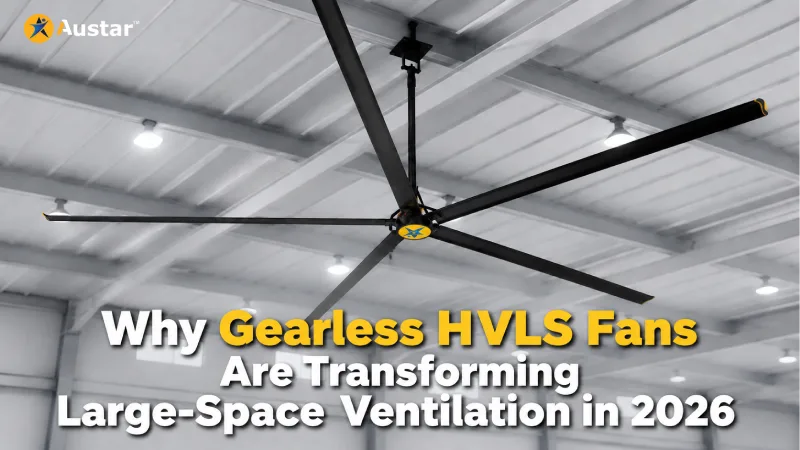
HVLS stands for High Volume, Low Speed. Unlike conventional ceiling fans that spin fast and cool a small area directly beneath them, an HVLS fan rotates large blades — typically ranging from 12 feet to 24 feet in diameter — at a low RPM to move enormous volumes of air gently and consistently across a wide floor area. The term "gearless" refers to the drive mechanism at the heart of the fan. A conventional or "geared" HVLS fan uses a gearbox to step down motor speed and transfer torque to the blades. A Gearless HVLS Fan, on the other hand, uses a direct-drive Permanent Magnet Synchronous Motor (PMSM), which connects the motor shaft directly to the fan hub with no intermediate gearbox at all.
This seemingly small engineering distinction has enormous real-world consequences. Removing the gearbox eliminates the single most failure-prone component in a traditional HVLS fan. There is no oil to change, no gear teeth to wear, no mechanical play to develop over years of operation. The result is a fan that runs quieter — typically under 40 decibels — lasts longer and demands almost nothing in terms of ongoing maintenance.
Why 2026 Is a Turning Point for Gearless Ventilation in India
India's industrial sector has been undergoing a rapid transformation. The push for energy efficiency under various government initiatives, combined with rising electricity tariffs and an increased awareness of worker comfort and productivity, has forced facility managers to look beyond old-school pedestal fans and window-mounted air coolers. At the same time, large-format infrastructure — mega warehouses for e-commerce, multi-level car parks, greenfield manufacturing plants, and modern sports complexes — has created spaces that conventional ventilation simply cannot handle economically.
A single Gearless HVLS Fan from a credible Gearless HVLS Fan Manufacturer in India can effectively cover anywhere from 3,500 to over 18,000 square feet of floor area depending on its diameter and ceiling height. Replacing the same coverage with pedestal fans or split air-conditioning units would require dozens of units, exponentially higher energy consumption, and significantly more maintenance overhead. The arithmetic is straightforward, which is why adoption has accelerated dramatically across sectors.
The Technology Behind the Transformation
The PMSM motor at the core of a gearless HVLS fan is not new technology in itself — it is widely used in electric vehicles, high-efficiency pumps, and servo systems. What makes its application in large ceiling fans significant is the combination of high torque at low speed, exceptional efficiency, and compact form factor. The motor does not need a gearbox because it can generate sufficient torque at the low RPMs required to turn 12-to-24-Feet blades directly.
Variable Frequency Drive (VFD) controllers’ pair with these motors to allow smooth speed adjustment, soft start and stop cycles, and precise airflow control for different conditions — day-to-night temperature swings, occupancy changes, or seasonal transitions. The overall system is digitally manageable, which aligns perfectly with the Industry 4.0 movement that many Indian manufacturers are now actively pursuing. When you connect a Gearless HVLS Fan to a building management system, you gain the ability to automate ventilation schedules, monitor energy draw in real time, and respond intelligently to occupancy sensors or temperature data.
Applications: Where Gearless HVLS Fans Deliver Maximum Impact
The versatility of gearless HVLS fans is one of their most compelling attributes. They are not a product designed for one sector — they are genuinely useful wherever large, populated or process-critical spaces need controlled air movement.
Warehouses and Logistics Hubs: The e-commerce boom has produced warehouse buildings that stretch across hundreds of thousands of square feet. Inside these spaces, stagnant air creates condensation on stored goods, uncomfortable working conditions for staff, and elevated humidity that damages certain product categories. A well-planned installation of Gearless HVLS Fans keeps air moving continuously, preventing condensation and creating a significantly more comfortable environment for workers whose productivity directly affects business outcomes.
Manufacturing and Industrial Plants: On the factory floor, heat generated by machinery and human activity accumulates rapidly. Excessive heat causes worker fatigue increases error rates, and in some industries creates safety risks. Gearless HVLS fans distribute fresh air evenly at floor level while drawing stale, hot air downward from the ceiling zone, normalizing the temperature gradient across the entire working area. Automobile plants, textile mills, food processing units, and pharmaceutical manufacturing facilities across India are among the most enthusiastic adopters.
Airports and Railway Stations: Public transit infrastructure presents a unique ventilation challenge — enormous volumes, constantly changing occupancy, strict noise limits in passenger areas, and the need for uninterrupted operation. Gearless fans operate at noise levels below 40 dB, making them virtually inaudible in the ambient soundscape of a busy terminal. Their reliability and minimal maintenance requirements also make them ideal for installations where unplanned downtime is simply not acceptable.
Gymnasiums, Sports Halls, and Community Spaces: Athletes and fitness enthusiasts are acutely sensitive to air quality and temperature. Stale, humid air in a gym not only degrades performance but also accelerates the growth of odour-causing bacteria. Gearless HVLS Fans move fresh air continuously without creating the cold draughts that disrupt play or cause discomfort during cool-down periods. Shopping malls, community halls, and places of worship are similarly well-served by the silent, consistent airflow these fans provide.
Key Benefits That Are Driving Adoption in 2026
Dramatic Energy Savings: One of the most frequently cited reasons for switching to gearless HVLS technology is the impact on electricity bills. These fans consume a fraction of the power that an equivalent air-conditioning setup would draw. In combination with reduced air-conditioning load — because large-area air movement dramatically lowers the perceived temperature — facilities routinely achieve energy cost reductions of up to 30% on HVAC-related expenditure. For large industrial operations running 24 hours, this translates into significant annual savings.
Near-Zero Maintenance Requirements: The absence of a gearbox means there is no gearbox oil to change, no gear mesh to inspect, and no mechanical wear components that degrade over a predictable service cycle. The PMSM motor itself is robust and long-lasting. Routine upkeep is limited to periodic blade cleaning and an annual electrical inspection. This makes gearless fans not just more economical to run but substantially easier to manage from a facilities perspective.
Silent Operation: In noise-sensitive environments — hospitals, educational institutions, call centers, hotel lobbies, showrooms — the acoustic profile of any installed equipment matters enormously. Gearless HVLS fans operate at under 40 dB, a level that sits well below conversational speech and is unlikely to be noticed by occupants.
Improved Air Quality and Worker Health: Consistent air movement prevents the stratification of hot and cold air layers, eliminates stagnant pockets where humidity and contaminants accumulate, and reduces condensation on floors and surfaces. Workers in well-ventilated environments report fewer heat-related complaints, lower fatigue levels, and better sustained concentration.
Environmental Responsibility: Industrial and commercial operations in India are under growing pressure to reduce their carbon Footprint. Replacing energy-intensive cooling infrastructure with efficient, long-lasting Gearless HVLS Fans contributes meaningfully to scope-2 emission reductions, supports sustainability reporting, and demonstrates a genuine commitment to responsible operations.
Why Choose Us
Austar Technologies has established itself as India's most trusted Gearless HVLS Fan Manufacturer in India, with over 4,500 successful installations across 28 Indian states and a manufacturing facility rooted in the industrial heart of Ahmedabad, Gujarat. What separates Austar Technologies from other players in this space is a combination of engineering integrity, transparent customer relationships, and an after-sales commitment that continues for the life of the product. Every fan that leaves the factory carries CE certification, reflecting compliance with global safety and performance standards that go well beyond the minimum required by domestic regulations. Austar Technologies maintains direct management involvement in quality control, which means that the people accountable for product performance are the same people overseeing its production. The company offers lifetime support and maintenance, a well-established pan-India sales and service network with 8 service centers and a 48-hour dispatch SLA, and pricing that delivers international-grade quality without the premium of imported alternatives. When you choose Austar Technologies, you are not buying a fan — you are investing in a long-term ventilation partnership built on proven performance and genuine accountability.
Conclusion
The shift toward Gearless HVLS Fan technology in 2026 is not a passing trend — it is a structural change in the way India's industrial and commercial sectors think about air movement, energy consumption, and worker wellbeing. Facilities that make this transition gain a measurable competitive edge through lower operating costs, healthier working environments, and a reduced environmental Footprint. As India's infrastructure continues to scale upward, the demand for smarter, quieter, and more efficient ventilation will only grow. Partnering with a proven Gearless HVLS Fan Manufacturer in India like Austar Technologies positions your facility to meet that demand with confidence and long-term reliability.
Ready to upgrade your facility's ventilation with India's most trusted Gearless HVLS Fan Manufacturer in India? Explore how Austar Technologies can transform airflow, cut energy costs, and create a healthier workspace for your team — because great ventilation is the foundation of a productive facility. +91 98246 85566 or email online@austarfansindia.com