
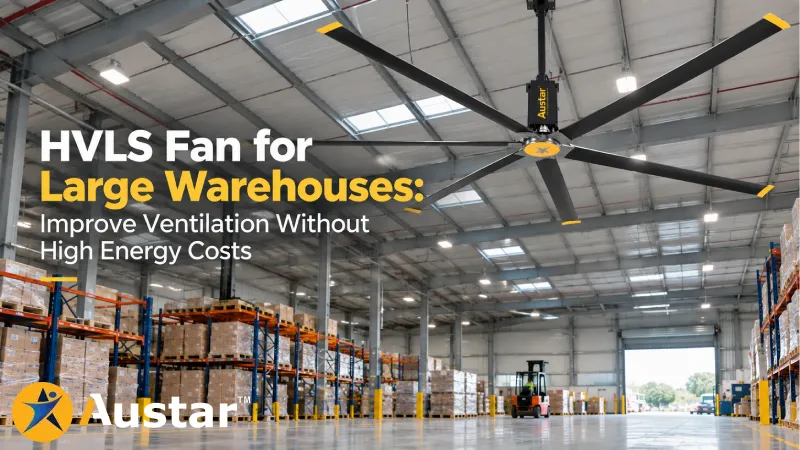
Key Takeaways
- HVLS fans provide wide-area airflow, improving ventilation in large warehouses without high energy costs.
- Choosing an HVLS fan for warehouses reduces the need for multiple smaller fans, simplifying maintenance.
- These fans operate quietly, creating a more comfortable working environment in busy warehouse settings.
- Austar Technologies offers both geared and gearless HVLS fan options to meet different warehouse needs.
- Properly selected HVLS fans enhance air circulation, addressing specific warehouse layouts and operational requirements.
Austar Technologies is a leading manufacturer of HVLS Fans. Large warehouses need more than simple air movement. They need consistent ventilation across wide floor areas, especially where conventional fans may leave some zones with limited airflow. An HVLS Fan For Warehouses can provide broad air circulation while using a practical, low-energy approach for large industrial spaces.
Why Large Warehouses Need Better Air Circulation
Warehouses often have high ceilings, large open floor areas, storage racks, equipment and busy working zones. Because of this layout, ordinary fans may not circulate air effectively throughout the entire facility.
An HVLS fan is designed to move a large volume of air at a relatively low rotational speed. The wide blades create a broad airflow pattern that can help distribute air across large areas rather than concentrating airflow in a small spot.
For warehouse operators, better air movement can make the overall indoor environment more comfortable and better ventilated.
How an HVLS Fan Works in a Warehouse
The working principle is straightforward. A large-diameter fan installed at a suitable ceiling height moves air downward and outward across the warehouse floor. As the air travels through the occupied area, it creates continuous circulation.
The result is not simply a stronger breeze directly below the fan. The airflow is intended to cover a wider area, making HVLS technology suitable for expansive industrial and commercial facilities.
An HVLS Fan For Warehouses can be particularly useful where installing numerous conventional fans would create a crowded ceiling arrangement and inconsistent airflow between different sections.
Main Benefits of HVLS Fans for Warehouses
Choosing the right fan is about more than airflow. Warehouse managers typically need a solution that fits the building layout, operating conditions and long-term maintenance requirements.
Here are some of the practical advantages:
- Wide-area airflow: Large blades distribute air across broad floor spaces.
- Lower energy demand: HVLS technology is designed for moving high air volumes without relying on numerous conventional fans.
- Quiet operation: Low-speed operation can help maintain a more comfortable working environment.
- Better circulation: Continuous movement helps reduce stagnant air zones.
- Space-efficient installation: One large fan can serve a broad area compared with multiple smaller ceiling fans.
- Industrial suitability: Heavy-duty construction can make HVLS fans appropriate for warehouses and manufacturing environments.
HVLS Fan vs Conventional Fans
The difference becomes easier to understand when both solutions are viewed from a warehouse-planning perspective.
| Factor | HVLS Fan | Conventional Fans |
|---|---|---|
| Air coverage | Broad area | More localized |
| Fan quantity | Fewer large fans may be required | Multiple units may be needed |
| Air movement | High-volume, low-speed airflow | Focused airflow |
| Ceiling arrangement | Suitable for large open areas | More units can be needed |
| Energy approach | Designed for efficient large-area circulation | Energy use increases with multiple units |
| Typical application | Warehouses, factories and large halls | Smaller or segmented spaces |
The right choice still depends on warehouse dimensions, ceiling height, layout and ventilation requirements. A proper site assessment is important before selecting fan size and placement.
What to Consider Before Choosing an HVLS Fan
Not every warehouse has the same airflow requirements. Storage height, floor arrangement, machinery, working zones and ceiling structure can all influence the fan selection.
Before purchasing, consider these points:
- Warehouse area: Know the total floor area that needs air circulation.
- Ceiling height: The installation height affects airflow performance and fan selection.
- Internal layout: Racks, machines and partitions can influence the movement of air.
- Fan diameter: Select a suitable size based on the space and required coverage.
- Operating environment: Consider whether the facility is used for storage, manufacturing, packaging or another industrial activity.
- Control requirements: Speed control can be useful when airflow needs change during different operating conditions.
A properly selected fan should match the warehouse rather than being chosen only by diameter or appearance.
Reduce the Need for Multiple Small Fans
A large warehouse can become difficult to manage when many small fans are installed across the ceiling. More equipment can mean more individual mounting points, wiring and maintenance considerations.
An HVLS Fan For Warehouses takes a different approach by using a large fan to move air across a wide area. This can simplify airflow planning in open warehouse environments and reduce the need to depend entirely on numerous smaller fans.The objective is not simply to install the biggest fan available. The fan arrangement should be planned around the actual warehouse structure and operating needs.
Geared and Gearless HVLS Fan Options
Warehouses and industrial facilities may have different requirements, which is why HVLS fans are available in different configurations.
Geared HVLS fans use a gearbox-driven system, while gearless models use a motor-based direct-drive arrangement. Each configuration has its own design characteristics, so the appropriate option depends on the application and buyer requirements.
At Austar Technologies, we offer both geared and gearless HVLS fan solutions for industrial and commercial spaces. Our warehouse fan range includes large-diameter models intended for broad-area air circulation.
Why Choose Us
Austar Technologies focuses on HVLS fan solutions for large industrial and commercial spaces. Our product range includes geared and gearless models, with different fan sizes available for varying applications. We manufacture HVLS fans at our facility in Ahmedabad and provide solutions for warehouses, manufacturing plants and other large spaces. We work with businesses looking for practical airflow solutions that combine broad coverage, controlled operation and suitable industrial construction.
Conclusion
Improving warehouse ventilation does not always require a complicated cooling arrangement. The right air circulation system can make a significant difference in how air moves through a large facility. An HVLS Fan For Warehouses provides a practical approach by combining large-area airflow with low-speed fan operation, helping businesses manage ventilation without depending on a large number of conventional fans. Austar Technologies provides HVLS fan options for warehouses and other large spaces, helping B2B buyers select solutions based on their facility requirements, layout and airflow needs.
Looking for the right HVLS Fan For Warehouses for your facility? Speak with Austar Technologies for product information and assistance in selecting a suitable solution. Call: +91 98246 85566 Email: online@austarfansindia.com .