
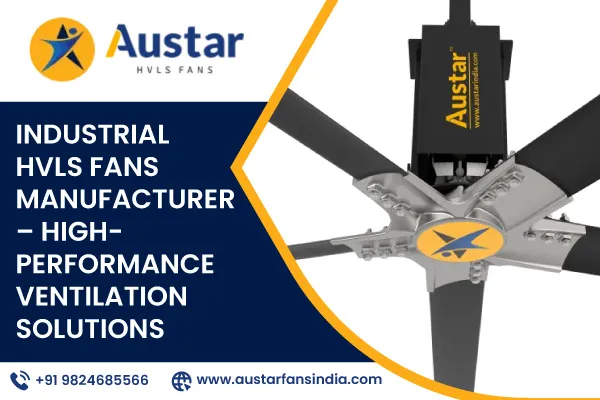
Large industrial and commercial facilities face a basic but decisive challenge: move enough air, quietly and efficiently, across tens of thousands of square feet. Traditional high-speed fans and spot coolers struggle with coverage, noise and operating cost. Industrial HVLS Fans offer a fundamentally different approach — slow-rotating, large-diameter rotors that generate broad, gentle air curtains to destratify and ventilate huge spaces. For factories, warehouses, logistics hubs and public venues, the right HVLS solution reduces heat stress, lowers HVAC loads and improves indoor air movement without huge energy bills. Austar Technologies designs and manufactures a wide range of HVLS solutions—HVLS Fan Manufacturers who combine aerodynamic blade design with modern motor controls to deliver quiet, durable, high-volume airflow for demanding environments.
What Are Industrial HVLS Fans?
The HVLS Principle
HVLS (High Volume Low Speed) fans move massive amounts of air using large-diameter rotors (typically 12–24+ feet). Instead of high-velocity blasts, HVLS fans create a broad airflow pattern that gently pushes air down from the ceiling and spreads it across the floor. This macro-circulation mixes air layers, reduces thermal stratification, and produces a perceivable cooling effect for people and equipment.
Market Categories
HVLS offerings split into several product families you will commonly see from top HVLS Fan Manufacturers:
- Gearless HVLS Fans — direct-drive motors with fewer mechanical parts.
- Geared HVLS Fans — compact motors running through reduction gearboxes for high torque.
- 5 Blade HVLS Fans — blade count and aeroform tuned for balance between thrust and noise.
- Commercial HVLS Fans and Big HVLS Fan models — product lines adapted to retail, airports or very large industrial halls.
Benefits, Features & Importance
Core Benefits
Industrial HVLS Fans reduce perceived temperature and even out environmental conditions across large footprints. Benefits include lower HVAC load, improved worker comfort and more consistent process conditions for sensitive operations.
Key Features
Modern HVLS fans from reputable HVLS Fan Manufacturers combine:
- Aerodynamic blades for efficient thrust.
- Low-noise motor systems for quiet operation.
- Robust mounting and certified safety elements for industrial duty.
- Smart controls and scheduling for energy management.
Business Importance
For industrial operations, effective air movement translates into measurable operational gains: fewer heat-related stoppages, preserved product quality in storage areas, reduced HVAC runtime and a better employee environment—each of which affects the bottom line.
Types & Technology: Gearless, Geared and Design Choices
- Gearless HVLS Fans – direct-drive PMSM motors eliminate gearbox friction, cut maintenance and run whisper-quiet for long hours.
- Geared HVLS Fans – compact motor + reduction gearbox deliver high torque for very large blades; proven in heavy-duty industrial plants.
- 5 Blade HVLS Fans – balanced blade count gives smooth airflow, lower noise and simpler structure; widely used in both factories and commercial spaces.
Applications & Industry Use Cases
- Warehousing & Logistics: Large, racked warehouses benefit from floor-level destratification and reduced humidity accumulation. A few well-placed Industrial HVLS Fans can replace many smaller units while cutting energy use.
- Manufacturing & Fabrication: In high-heat zones (welding, pressing), HVLS fans improve operator comfort and reduce localized hotspots that compromise process stability.
- Commercial & Public Spaces: Commercial HVLS Fans are applied in malls, exhibition halls and airports where quiet, aesthetic airflow is required alongside high coverage.
- Cold Storage & Food Processing: By carefully managing airflow patterns, HVLS fans support consistent product temperatures and reduce condensation risks without causing turbulence that damages product.
How to Choose the Right HVLS Fan — Selection & Specification Guide
- Assessing Coverage Needs – Begin with facility dimensions, ceiling height and obstruction layout. HVLS Fan Manufacturers use coverage charts and CFD-informed guidelines to recommend rotor size and number of fans.
- Drive System: Gearless vs Geared – Choose Gearless HVLS Fans when you prioritize low maintenance and quiet operation. Choose Geared HVLS Fans when the installation demands proven mechanical torque handling in heavy-duty cycles.
- Material, Certifications & Performance Metrics – Confirm structural materials, motor IP rating, product certifications and published airflow (CFM) at various RPMs. Reputable Manufacturers publish test data and performance curves.
- Controls & Integration - Smart control panels, app-based scheduling and BMS compatibility deliver operational flexibility and energy savings. Ask about real-time monitoring and remote diagnostics.
Installation, Maintenance & After-Sales Support
- Structural & Safety Requirements: HVLS installations require roof/ceilings that can support static and dynamic loads. Top HVLS Fan Manufacturers provide site surveys, GA drawings and engineer-signed load plans.
- Routine Care: Regular inspections focus on hub integrity, fastener torque, blade condition and motor diagnostics. Gearless HVLS Fans typically need less mechanical servicing than geared models.
- Service Network & Spares: Local availability of trained service teams and spare parts shortens downtime. Austar Technologies operates manufacturing and service networks to support installations across India.
Why Choose Austar Technologies
Austar Technologies combines Indian manufacturing scale with domain engineering to deliver HVLS fans tuned for real industrial conditions. Founded and operating from Ahmedabad, Gujarat, the company runs a large production facility with significant monthly capacity and a nationwide sales/service footprint—giving buyers access to engineered HVLS solutions, local commissioning teams and post-installation support. Austar’s product range includes Gearless HVLS Fans, Geared HVLS Fans, 5 Blade HVLS Fans and large Big HVLS Fan models tailored for commercial and heavy industrial needs, with certification and test-backed performance. The company reports a broad installed base across India and exports to international markets, reflecting both experience and delivery scale.
Conclusion
Selecting the right HVLS solution requires matching facility geometry, process needs and service expectations to product capability. Industrial HVLS Fans deliver a pragmatic, high-impact way to manage indoor air movement at scale—reducing HVAC load, improving comfort and supporting consistent process environments. Work with experienced HVLS Fan Manufacturers who provide clear performance data, local installation support and reliable after-sales service. Austar Technologies, based in Ahmedabad, Gujarat, offers a broad portfolio of Gearless HVLS Fans, Geared HVLS Fans, Commercial HVLS Fans and large Big HVLS Fan systems engineered for heavy-duty applications; their manufacturing scale and field experience make them a practical choice for industrial buyers.
For engineered HVLS solutions and site evaluation, call +91 98246 85566 or email online@austarfansindia.com to request a personalised proposal and airflow plan.